

A first check smaller than the estimate isn't necessarily a mistake. Most estimates are written at replacement cost, and many policies pay the actual cash value first.
NC DOI puts it this way: with replacement cost coverage, the insurer may first pay the actual cash value, then reimburse the rest once the item is repaired or replaced and you submit receipts. The sums can be right while the estimate itself is too low, though, so this guide covers both. Your own policy and the facts of your loss decide your claim.
One claim, line by line
Take a fictional roof claim. This is its estimate summary, usually the last page of the estimate:
| Line | Amount | What it means |
|---|---|---|
| Replacement cost value (RCV) | $18,000 | The price to repair the damage at today's prices |
| Less recoverable depreciation | $4,500 | The holdback. May be paid later, if you repair and meet the policy's conditions and deadline |
| Less non-recoverable depreciation | $1,500 | Will not be paid back. Ask which policy provision it rests on |
| Actual cash value (ACV) | $12,000 | Replacement cost minus all depreciation |
| Less deductible | $1,000 | Your share, set in your declarations. Some policies have a separate wind or hail deductible |
| Less prior payments | $0 | Any advance the insurer already paid |
| Net claim (this payment) | $11,000 | What the first check should be |
Up to $4,500 more may follow after the repairs; the $1,500 won't. Type your own summary's totals in below and the calculator does the same sums.
Try it with your estimate
Where did the rest of the estimate go?
Copy the totals from your estimate’s summary page. It starts on the fictional example above.
These numbers can’t all be right: the depreciation is more than the replacement cost, or the deductible and prior payments are more than the actual cash value. Check them against the summary page, and ask the adjuster in writing if the summary itself doesn’t add up.
- Estimated payment now
- $11,000
- Actual cash value $12,000, minus the deductible and prior payments
- May be paid after repairs
- $4,500
- Recoverable depreciation, only if you repair or replace and meet the policy’s conditions and deadlines. Not money set aside for you.
- Not coming back
- $1,500
- Non-recoverable depreciation. Ask which policy provision it rests on.
- Your deductible
- $1,000
- Taken off once per claim. It is not your whole cost: uncovered work, non-recoverable depreciation and a contractor’s price above the estimate can add to it.
This checks the insurer’s arithmetic, not whether its estimate is enough to repair the damage. Nothing you type leaves this page.
Which depreciation is recoverable
It depends on how your policy settles each kind of loss. Check the declarations page and the "Loss Settlement" section, or ask your agent for a copy.
- The dwelling, at replacement cost. Many homeowners policies follow the ISO HO 00 03 form. In its common editions, the insurer pays only actual cash value until the repair is done, unless the loss is under both $2,500 and 5% of the dwelling limit. Full replacement cost also requires dwelling coverage of at least 80% of the home's replacement cost just before the loss. Editions and endorsements vary, so check your own form.
- A roof with an actual-cash-value endorsement. The North Carolina Rate Bureau offers an endorsement that settles windstorm or hail damage to roof surfacing at actual cash value. If your policy has it, the roof's depreciation generally isn't recoverable, even after you replace the roof.
- Your belongings. The standard form pays personal property at actual cash value unless you added replacement cost coverage for contents. Our contents inventory guide covers documenting them.
- Actual-cash-value-only policies. NC DOI's FAQ notes that with only actual cash value coverage on your home, you receive only the depreciated amount.
Is the depreciation too high?
Depreciation is the insurer's estimate of the value the damaged part had already lost to age and wear before the loss. It's a judgment, and you can question it.
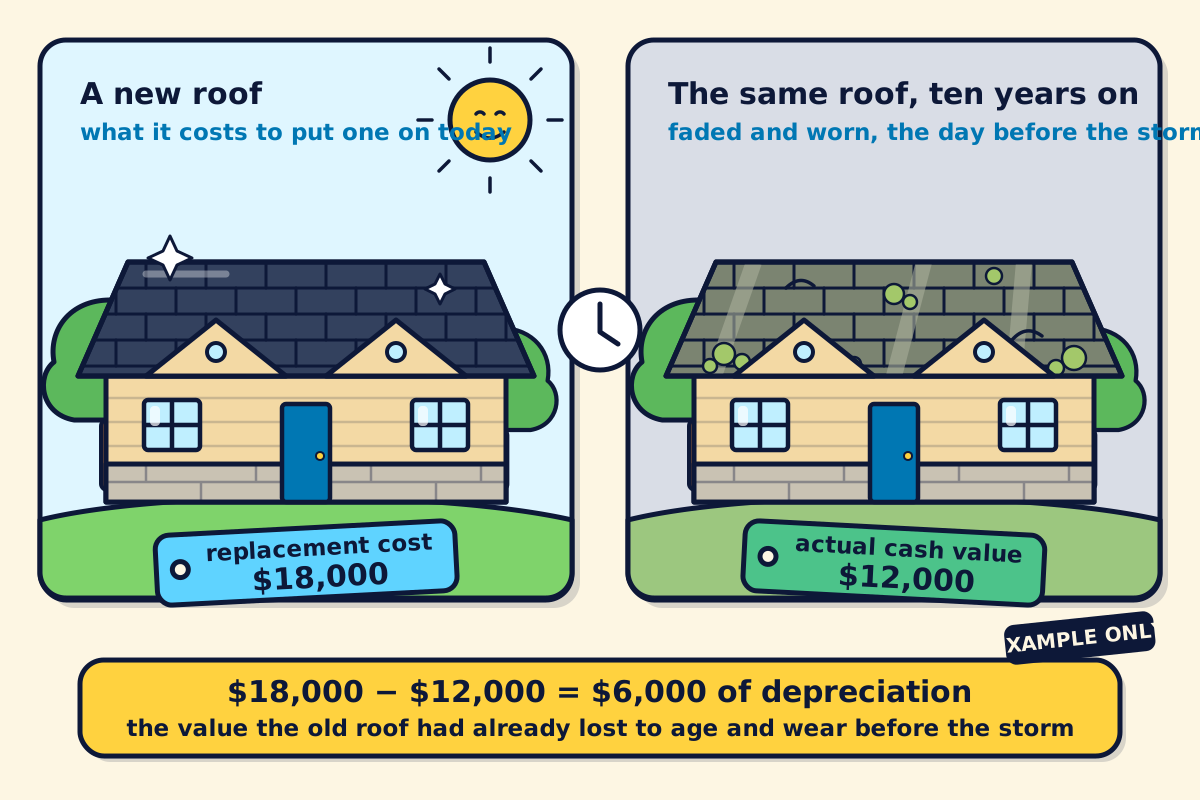
The same roof new and ten years on, before any storm. The lost value is the depreciation. Example only.
Illustration: Melo, after an NPS photo- Age and condition. If your roof was replaced six years ago and the estimate treats it as fifteen, send the invoice or permit.
- Life expectancy. Ask what useful life the insurer applied to each material.
- Labor. In Accardi v. Hartford Underwriters (2020), the North Carolina Supreme Court held that the policy in that case allowed depreciating labor as well as materials. It turned on that policy's wording, so read how yours defines actual cash value.
- Evidence. In Surratt v. Grain Dealers Mutual, the North Carolina Court of Appeals described the "broad evidence rule": any evidence that logically helps show the value at the time of loss may be considered, such as photos, invoices, maintenance records and a contractor's opinion of condition.
How to request recoverable depreciation
- Get the rules in writing before work starts. Ask for the deadline and the documents the insurer needs. NC DOI's FAQ says you can take actual cash value first and claim the additional replacement cost within 180 days after the loss, under your policy's loss settlement provisions. If the insurer has told you to go ahead with repairs, 11 NCAC 04 .0420 requires it to confirm in writing, if you ask, what it will pay for.
- Send the proof when the work is done. The contractor's final invoice, proof of payment if asked, and photos of the finished work. Under the standard form the total can't exceed what you actually spent or your coverage limit, so a job that comes in under the estimate gets less than the full holdback. If the contractor found more damage once the old material came off, send their itemized scope and photos and ask for a supplement.
- Track the payment. Note the date you sent everything, who received it and the claim number, and ask when and to whom the money will be paid.
Send this to your adjuster by email, so there's a record:
Please confirm the recoverable and non-recoverable depreciation amounts, the policy provisions supporting those amounts, the deadline to request replacement cost benefits, and the documentation required.
Three deadlines that are easy to mix up
- Claiming the extra replacement cost: often 180 days after the loss. In the common standard form, that's the deadline to tell the insurer you intend to claim it, not to finish the work. Send that notice in writing, well before the 180 days are up.
- Finishing the repairs: some policies set a separate time limit. Ask your insurer whether yours does.
- Proof of loss: many homeowners policies ask for a signed, sworn proof of loss within 60 days after the insurer requests one. For fire, the standard provisions in G.S. 58-44-16 set 60 days after the loss, unless the insurer extends that in writing, and three years after the loss to start a lawsuit. After a declared disaster, a Commissioner's order under G.S. 58-2-46 can pause the proof of loss deadline for homes in the disaster area. Speak with a North Carolina attorney well before any lawsuit deadline.
Paying the contractor while depreciation is held back
The first check may not cover the contractor's price, and the rest may arrive only after the work is finished. Don't assume anyone will advance it. Before you sign a contract, ask:
- Your insurer: how much it will pay now, what triggers the recoverable depreciation, and whether it will pay in stages for a large job.
- Your contractor: the payment schedule, how much is due before the final invoice, and whether they will wait for the insurer's final payment.
- Your mortgage company: how its loss-draft department endorses checks and releases money, whether it needs inspections, and how long each release takes.
What if the estimate is wrong?
Even when the sums add up, the estimate itself can be too low: missing damage, wrong measurements, prices below local costs, or no overhead and profit on a job that needs a general contractor. Each one shrinks every number after RCV.
- Ask for the explanation in writing. North Carolina's unfair claims practices law, G.S. 58-63-15(11), lists failing to promptly explain the basis for a denial or compromise offer, and paying without stating the coverage each payment is under.
- Answer line by line. Send your contractor's itemized estimate and photos, pointing to the exact lines, not just a total.
- Consider appraisal. When you and the insurer disagree on the amount of loss, G.S. 58-44-16 lets either side demand appraisal in writing. Each side picks and pays its own appraiser, the two choose an umpire whose cost is shared, and any two of the three set the amount. It decides how much, not whether something is covered. Read about property damage appraisal in Charlotte.
- Use NC DOI. You can file a complaint online or at 855-408-1212. NC DOI can require your insurer to respond, but it can't set the value of your claim. After some declared disasters, the Commissioner also activates a free disaster mediation program for that disaster's home insurance claims denied in whole or in part, over the amount or the cause of loss. You must ask within 60 days of the denial.
Checklist
Save or print this
What to check on your estimate
- RCV, minus depreciation, the deductible and prior payments, equals the check
- Depreciation is split into recoverable and non-recoverable, and I know why any is non-recoverable
- The roof's age and condition match my records
- Every damaged area is in the estimate, with the right measurements
- I know whether my policy pays replacement cost for the dwelling, the roof and my belongings
- I have the deadline to claim recoverable depreciation in writing
- I know how my contractor and mortgage company will be paid
- I've read the check and its letter for "full and final" language
When to get help
Get help when the numbers stop making sense: depreciation that looks too high, a wrong roof age, an ACV roof endorsement you didn't know about, missing damage, or a deadline you're worried about.
A licensed public adjuster works for you, not the insurer. Under Article 33A of Chapter 58:
- The contract must state the fee, and you can cancel it in writing within three business days.
- The fee is a percentage of each insurance check as it's paid, including later checks for recoverable depreciation or a supplement, not the whole fee out of the first one.
- The public adjuster can't settle your claim without your knowledge and consent.
- After a catastrophic incident declared by the President or the Governor, G.S. 58-33A-60 caps the fee at 10% of the settlement and bars any fee, retainer or deposit before the claim is settled.
Request a free claim review or call (704) 286-0707, with your estimate and payment letter ready. The review is free; paid representation is separate and needs a written agreement. Dealing with roof damage? See our hail and roof damage claim services in Charlotte.

.jpg)